
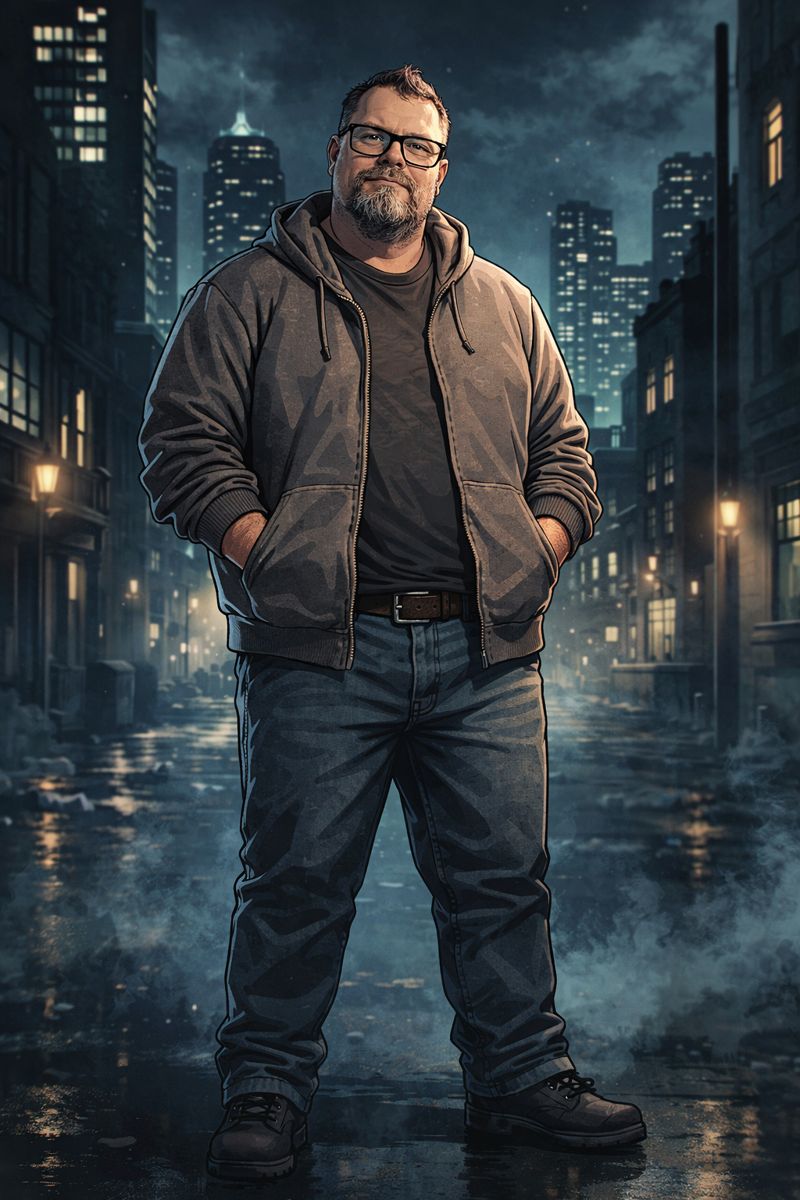
Ozzy and Bertrum were waiting outside the shop when his now-blue car pulled in.
I dragged myself out of the driver’s seat with all the dignity of a man held together by adrenaline, spite, and whatever pure stupidity was circulating through my system.
Ozzy’s eyes widened.
Bertrum landed on the roof of the Mini, peered down at me, and as usual was the first to comment.
“You look like hell decided to tenderize you, boss.”
I grunted.
That felt like the appropriate level of acknowledgment.
Then Ozzy’s gaze dropped to my left arm and his expression shifted from surprise to immediate alarm.
“Chance,” he said, voice going high and sharp, “there is an obsidian spike in your arm.”
I nodded once.
“Yeah.”
I looked at it too, like maybe if I regarded it casually enough it would become less medically concerning.
“I didn’t want to pull it out and risk, you know…” I made a vague gesture with my good hand. “…leaking all my strawberry preserves. So I figured it was better to leave it in there until somebody with actual medical competence got involved.”
That seemed, under the circumstances, like sound reasoning.
Then I paused.
Because now that the adrenaline was bleeding off, everything hurt.
The cuts.
The bruises.
The shallow stab wound.
The blood loss.
The fact that I had apparently decided today was a good day to fistfight a racketeer wizard and his geological opinions.
The world tilted gently to one side.
“Also,” I said, because priorities matter, “you should see the other guy.”
I got that much out before my vision narrowed, my knees reconsidered their contractual obligations, and I sagged back into the open car door and more or less collapsed onto the driver’s seat again.
Ozzy swore.
Bertrum flapped down from the roof in a burst of black feathers and landed on the steering wheel, looking far more concerned than he’d ever admit to if asked later.
“Please remain conscious,” he said briskly. “You are dramatically more useful that way.”
“I’m trying,” I muttered.
Ozzy was already moving, surprisingly quick for a man of his build.
“Inside,” he said. “Now. We are getting you patched up before you bleed on my upholstery or die in my parking lot.”
“Fair,” I said weakly.
And between one worried curio dealer and one extremely judgmental raven, I was hauled out of the Mini and guided back toward the shop before I could disgrace myself by fully passing out.
I’ll give Ozzy this: he may only be a minor magical talent, but as occultists go he has a little bit of everything and, more importantly, knows what all of it does.
He was also much better at first aid than I would have guessed.
He sat me down in an old barber chair in the back room—a chair he claimed was an authentic occult relic that had once belonged to Doc Holliday. Which, by the way, is incredibly cool, and yes, I have tried to buy it off him more than once. He refuses to sell it.
I don’t blame him.
The next thing I knew, Ozzy was rummaging through shelves, drawers, and half-collapsed boxes in the back room for dried herbs, gauze, little jars of suspicious powders, and weird medical odds and ends from at least six different magical traditions. He also produced a battered metal toolbox and an ugly pair of pliers clearly intended for the obsidian spike in my arm.
He moved with the brisk, focused energy of a man who had done this sort of thing before and preferred not to discuss why.
By the time he turned back to me, arms full of supplies, he looked less like a curio dealer and more like some kind of eclectic arcane chirurgeon who had learned battlefield medicine from smugglers, hedge witches, and at least one lunatic with no proper licensing.
He set everything down within easy reach, then picked up a leather strap.
I opened my mouth without argument and bit down on it immediately.
No point pretending I didn’t know what came next.
Ozzy gave me a brief nod—professional, approving—then selected a bottle of vodka from the pile. Good stuff, too. Clear, high proof, probably intended for ritual sterilization but close enough to moonshine that the distinction felt academic.
He took a swig first.
“Medicinal,” he said around the burn.
Then he poured the rest directly over the wound in my arm.
I bit down so hard on the leather strap I felt my jaw complain.
Pain flared white-hot and immediate, vodka flooding the puncture channel and every tiny cut around it like liquid fire. It ran down my forearm, cold at first, then savage, stripping blood and grit and whatever microscopic bits of street and volcanic glass had decided to join the party.
It also helped, in a brutal sort of way. Alcohol in the bloodstream, fumes up the nose, nerves too offended to be subtle about anything.
Then he got to the next part.
He cut the sleeve of my coat clean off first, then my shirt beneath it, careful not to jostle the obsidian more than absolutely necessary. The ruined fabric dropped away, and there it was in all its glossy black malice—a wicked shard of volcanic glass buried in my left forearm at an angle I did not care for in the slightest.
I stared at it.
Then very deliberately looked away.
“Tell me if it’s in the bone,” I said through the strap.
“No,” Ozzy replied after a quick inspection. “Missed bone. Missed the artery too. You’re having a lucky day.”
“Your definition of lucky is sick.”
He snorted and set to work.
First came practical medicine.
He palpated around the wound with blunt, surprisingly gentle fingers, testing the angle of the shard, the depth, the resistance. He cleaned again, this time with gauze and something sharp-smelling and herbal that stung in an entirely different register than the vodka. He packed clean cloth around the entry point, not to stop the bleeding yet but to control it when the spike came free.
Then came the magical side of things.
Ozzy lit a little brass coal burner and dropped onto it a pinch of dried yarrow, comfrey, and something resinous and bitter I didn’t recognize at first sniff. The smoke that rose was thin and blue-gray, and the room filled with the dry, medicinal scent of old field hospitals and older hedgecraft.
He took a little dish from the shelf, mixed powdered shepherd’s purse with a few drops of honey and what looked suspiciously like ground pearl or mother-of-pearl, then added a whispered word over it in a dialect I didn’t catch—something old, something folkish, not ceremonial so much as inherited.
He painted a line of charcoal and ash just above the wound, tracing a short binding mark to keep the bleeding from getting ideas.
“Bit of Pennsylvania Dutch,” he muttered when he saw me watching. “Bit of cunning-craft, bit of old Catholic charmwork stripped down so it behaves.”
“Comforting.”
“Shut up and stay still.”
Then he took the pliers.
I made a noise through the leather strap that was not remotely dignified.
Ozzy braced my arm with one hand, got the ugly jaws of the pliers around the exposed obsidian, and tested it once. Just once. Feeling for the give.
“On three,” he said.
That was a lie.
He pulled on two.
The pain was immediate, electric, and primal—the kind of pain that bypasses thought completely and goes straight to the lizard brain screaming something is taking a piece of you with it. My back arched against the barber chair. My vision went white at the edges. The leather strap creaked alarmingly between my teeth.
The shard slid free in one long, wet motion, black glass slicked crimson, and for a horrible half second I felt the empty shape it had left behind as clearly as the shard itself.
Then the blood came harder.
Ozzy was ready for that.
He slapped pressure on the wound with a folded compress already dusted in powdered herbs, then pressed his thumb over the binding mark and spoke sharply in another language—this time Latin, clipped and practical. The charcoal sigil flashed just enough to sting my skin, and the blood flow slowed from alarming to merely concerning.
He held the pressure there while packing the wound with a paste made from mashed comfrey, yarrow, and some thick dark salve that smelled faintly of pine pitch and iron.
“Knits flesh,” he said. “Also tastes awful if you ask.”
“I wasn’t planning to drink my arm dressing.”
“You’d be amazed what I’ve seen.”
Once the forearm was bandaged and wrapped tight, he moved to the cut in my thigh.
That one had bled more into the denim than I liked, and when he cut the fabric away the air hit it with a sting that made me hiss.
“Deep enough to stitch,” he said.
“Wonderful.”
He threaded a curved needle from his first aid kit with black suture thread, then held the needle over the burner until it glowed dull orange. Crude sterilization, but effective.
“Stay still,” he said, voice dropping into the kind of tone you either obey or regret not obeying.
He didn’t numb it.
Didn’t have time, and honestly, after everything else I was so full of pain I was beginning to categorize it for efficiency.
Still, when that hot needle bit into the edges of the cut and started drawing them together, I felt every single pass. The pull of thread. The push through flesh. The heat. The pressure. My fingers dug hard enough into the arms of Doc Holliday’s allegedly haunted barber chair that I may have left impressions.
Ozzy worked fast.
Much faster than a man his size had any right to.
His hands were deft, economical, confident—no wasted motion, no fumbling, no theatrical pauses to admire his own work. Needle in, through, pull tight, knot, next stitch. A back-alley whipstitcher’s speed married to an occultist’s understanding of what flesh, energy, and intent all look like when they’re trying to come apart.
By the time he was done, the wound was closed, dressed, and dusted with a final pinch of powdered herbs over which he traced a little sign against infection from some other magical tradition entirely.
Chinese? Balkan? Something roadside and old.
At that point I no longer cared.
Fat Ozzy, I decided in the intervals between agony, was a very interesting man.
Faster than anyone gave him credit for.
Far more dexterous than his cheerful curio-shop-owner exterior suggested.
And equipped with precisely the kind of skill set you’d expect from a back-alley doc with a colorful past—not a guy who owned a magical pawn shop and went home at night to a wife and kids in some perfectly ordinary suburb in the Greater Toronto Area.
Which, now that I thought about it, made me like him even more.
Bertrum had not watched the whole procedure.
Not all of it.
He’d perched nearby through most of the operation, but at the grislier moments—namely the extraction of the obsidian spike and the stitching—he’d tucked his face behind one raised wing in a very pointed display of avian disapproval.
He was still there when Ozzy finished wrapping the last bandage, though, and once the immediate horror show had ended he lowered the wing and looked at me with one dark, glossy eye.
“I suppose,” he said thoughtfully, “that no good deed really does go unpunished, eh boss?”
I let my head rest back against the chair and closed my eyes for a second.
“Don’t make me laugh,” I muttered. “It hurts too much.”
Bertrum clicked his beak in what I suspected was sympathy disguised as sarcasm.
Ozzy, meanwhile, was tidying up with the brisk competence of a man who had just performed impromptu arcane battlefield surgery and would now like credit in the form of everyone not bleeding on his floor.
“You’ll live,” he said.
“That is the nicest thing anyone’s said to me all day,” I replied.
He snorted.
“Don’t get sentimental. You’re not done yet.”
That was the problem, wasn’t it?
He was right.
Nadali was alive.
Bruised. Humiliated. Disarmed.
But alive.
And men like him didn’t tend to walk away from humiliation and call it personal growth. They called it a debt.
I opened my eyes and looked down at the fresh wrappings, the blood-stiff fabric, the ache radiating through my arm and leg like a steady reminder from the universe that heroics have invoices.
“Yeah,” I said quietly. “I know.”
Bertrum hopped a little closer, feathers settling now that the worst of the gore was behind us.
“At least,” he offered, “you got his rings.”
That pulled my attention back into focus.
Right.
The rings.
“I’ll examine them when I don’t feel like I’ve got one foot in the grave,” I said grimly.
Ozzy snorted. “Oh, suck it up, buttercup.”
I huffed, which immediately reminded me why huffing was a bad idea right now. “Fine. But yeah—proper look when I’m back in my lab and operating at, let’s say, seventy-five percent functionality instead of… whatever this is.”
Ozzy shrugged like a man who had already moved on to the practicalities. “Figured they were magic the second he walked into my shop. What do you think they do, Chance?”
I leaned back in the chair, letting my head rest for a second while my brain did what it always does—reach for structure, for theory, for something clean and logical to hang the chaos on.
“Elementally attuned spell-focus items,” I said slowly. “And more than that—binding anchors. Each ring probably houses or tethers an elemental. Not just a conduit—an actual resident. Power source and partner, if you want to get romantic about it.”
I rolled my shoulder experimentally and immediately regretted it.
“Red for fire, blue for water, green for earth, orange—probably air by his schema. Could be variations in temperament too. Fire’s aggressive, earth’s stable, water’s adaptable, air’s… well, air’s a bastard to predict. If he’s been working with them long enough, they’re not just tools—they’re habits. Extensions of how he thinks.”
Ozzy nodded, considering that like he was pricing it for resale.
“Dangerous, then.”
“Very,” I said. “Especially if I’m right about the binding. If those things are keyed to him, they might not like being separated. Could be backlash. Could be dormant. Could be they decide I look like a perfectly reasonable new landlord.”
Bertrum made a soft, disapproving noise.
“Yes, thank you,” I muttered. “That’s exactly the concern.”
Ozzy clapped his hands once, decision made. “Well, whatever they are, you’re not figuring it out bleeding all over my floor.”
He jerked a thumb toward the front.
“Your van’s about as useful as tits on a bull right now.”
I nodded. Hard to argue with that. Last I saw, the wizard mobile was looking as rough as I was after all it had been through.
“So,” Ozzy went on, grabbing his keys, “I’ll drive you and the bird home, and we can agree not to tell anyone I patched you up for free.”
He gave me a small smile.
The kind that translated very clearly to: I’m a good guy… but I also own a baseball bat and know how to use it.
I snorted, then winced immediately. “Your secret’s safe. I’d like to keep both kneecaps.”
“Smart man.”
Bertrum hopped up onto my shoulder with exaggerated care, as if I were suddenly made of glass.
“Try not to die on the way,” he added helpfully.
“No promises,” I muttered, hauling myself upright with all the grace of a man held together by stitches, spite, and questionable life choices.
Ozzy flicked off the lights as we headed out.
Behind us, the shop settled back into its usual quiet—shelves full of strange things, each with their own stories, their own dangers.
In my pocket, the rings felt heavier than they had any right to.
And I had the distinct, unpleasant feeling that the story attached to them wasn’t finished yet.
But that would have to wait.
I had things to do.
Before we headed home, I asked Ozzy for one more stop.
He didn’t argue. Just gave me a look that said this better be worth it, then swung the car through a couple of late-night streets and parked near Baily’s apartment.
I stepped out carefully, now dressed in a borrowed set of grey sweatpants and an old band tee Ozzy had dug out for me. It smelled faintly of incense, motor oil, and something herbal I couldn’t place. Honestly, it was an upgrade from blood-soaked denim.
“I’ll be right back,” I said.
Ozzy nodded from behind the wheel, watching me like he was timing how long it would take before I collapsed.
Bertrum shifted on my good shoulder, claws gentle for once, and together we made our way up to Baily’s door.
I knocked exactly three times.
No more. No less.
There was a pause—then I felt it.
Locks disengaging.
Not just physical ones. The subtle prickle of threshold wards loosening, like something unseen taking a breath and deciding I was allowed through.
The door opened.
Baily stood there, eyes wide, taking me in.
“Oh goddess, Chance—are you okay?”
I paused, then gave her a crooked smirk.
“Been better,” I admitted. “But I’ll recover.”
Her gaze flicked over the bandages, the stiffness in how I held myself, the general wrecked state I was in.
I lifted a hand slightly, like that would somehow make it all look less dramatic.
“I just wanted to let you know,” I continued, “the guys who broke into your shop? The ones who robbed you?”
I shrugged, wincing a little as I did.
“They shouldn’t be a problem anymore.”
For a moment, she just looked at me.
Then she smiled.
It wasn’t flashy or dramatic. Just… warm. Real. The kind of smile that made the whole mess feel like it had actually meant something.
I could see the instinct in her—to step forward, to hug me—but she held back, reading the situation correctly. A hug right now might actually kill me.
“Thank you, Chance,” she said softly.
I shook my head.
For a split second, my brain tried to do the math—repair costs, medical supplies, ruined clothes, time off, the sheer logistical headache of everything I’d just put myself through.
Then I pushed it aside.
Because the way she said thank you?
That felt like I was being overpaid.
“Don’t worry about it,” I said. “I can’t stay long. I’ve got to get home and, you know… do that sleeping thing other people do.”
Bertrum gave a solemn nod, as if this were the wisest statement I’d made all night.
Baily laughed softly, then nodded. “Okay. But next time you come into the shop, your order’s on the house. Deal?”
I straightened just a little, energy sparking through the exhaustion.
“Score!”
I pumped my good arm like I’d just won a grand prize, immediately regretted it, and tried very hard not to show that I regretted it.
She smiled again.
I turned and headed back to the car.
The night air felt cooler now. Quieter. The kind of calm that settles in after something loud and violent has already burned itself out.
Ozzy didn’t say anything when I got back in. Just started the engine and pulled away.
Bertrum tucked himself in close, feathers brushing my cheek.
And for the first time since the whole mess started, I let myself relax—just a little.
Because this part?
This part was done.
***
Over the next days—weeks, really—I’d have work ahead of me.
The rings needed studying.
Nadali needed watching.
Promises needed verifying.
And there would be fallout. There’s always fallout. The Goblin Market would whisper. The local magical community would poke at the edges of what happened, trying to figure out where the cracks were and who might slip through them.
That was future Chance’s problem.
Right now?
Right now I was alive, mostly intact, and heading home.
All things considered, I’d call that a win.
***
All in all?
Just another chapter in the life of Chance Blackwell—wizard, professional disaster magnet, owner of a hero complex and a far less developed sense of self-preservation than was medically advisable.
Still.
I had enough wits, enough stubbornness, and just enough dumb luck to keep making it work.
-The End