The first month of the end of the world did not look like fire. It looked like folding chairs and generator lights. The sanctuary of The Fellowship Community Church had become a theater. The stained glass was boarded over. Candles burned where fluorescent panels had died. The air smelled of kerosene and unwashed bodies. At the center of it stood Pastor Pete. He did not tremble when he preached. He performed. His voice carried like thunder. He had learned that resonance in seminary. Learned Greek verbs and church history and rhetorical cadence. He knew how to let silence swell before a declaration. He knew when to whisper. He knew when to pound the pulpit. He had always loved that moment when a crowd leaned forward together. Not because he believed. Because they did. And their belief felt like warmth.
Beside him stood Sister Selma, composed, luminous in a way that had nothing to do with the lantern light. She managed the details. She found the broken and coached them. She hired the desperate. The healings were choreographed. A limp rehearsed. A testimony memorized. A stagger into the aisle at just the right moment. Pastor Pete would descend from the platform, lay hands, speak in trembling conviction. He would close his eyes as if listening to heaven. The crowd would hold its breath. Then, a gasp. A cry. A man standing straighter than he had in years. Hope would explode like fireworks. Pete always felt sick afterward, sick and exultant. He told himself it was harmless. He told himself hope was worth a little theater. He told himself that belief, even manufactured, could keep people from killing each other. He did not ask what that made him.
Brother Grimm did not discover the truth in the sanctuary. He discovered it in a bar twenty miles out of town. The place was called The Lantern’s End. It survived the collapse because its owner had a generator and didn’t ask questions. It smelled of sour beer and diesel fumes. Grimm had sworn off alcohol when the world cracked. He had not sworn very well. He sat at the bar in his collarless coat, nursing something that burned more than it soothed. His hands were scarred from helping board windows and bury bodies. His faith had been the one thing he believed unbreakable. Then he heard a laugh he recognized. He turned. There, at a corner table, was Aaron Mott. Three nights earlier, Aaron had shuffled into the aisle of The Fellowship dragging a twisted leg. He had wept as Pete prayed. He had shouted when he “felt warmth.” He had dropped the crutch and walked. The congregation had sobbed. Tonight, Aaron stood from the table to greet a friend. He walked perfectly. No limp. No stiffness. He slapped the table and said, “You should’ve seen their faces. When I dropped the crutches and walked, they ate it up! Easiest money I ever made.”
No, the world did not end with fire. For Brother Grimm, it ended in that sentence. He did not confront the man there. He finished his drink, slowly, deliberately. He watched Aaron walk out into the night with the easy stride of a man that had never know injury. Grimm felt two things battling in his chest. Righteous fury and dread. He confronted Pete after the evening service. The congregation had dispersed to their bedrolls. Sister Selma had gone to inventory supplies. The generator hummed low and steady. Pete stood at the pulpit counting envelopes of donated ration vouchers. Grimm did not announce himself. “Does it pay well?” he asked.
Pete looked up with that practiced pastoral softness. “Brother Grimm. I didn’t see you.” “No,” Grimm said. “You don’t.” He stepped into the aisle, boots heavy on the wood. “I was at The Lantern’s End tonight.” Pete’s smile thinned, almost imperceptibly. Grimm continued, “Aaron Mott was there. Talking, bragging.” The silence that followed was not theatrical. Pastor Pete set the envelopes down carefully. Grimm’s voice sharpened. “You healed him. You laid hands on him before God and these people! You called down heaven!” Pete said nothing. Grimm’s jaw clenched. “And tonight, he bragged about the money, about the show.” There it was. Pete did not deny it. Instead, he sighed, not in guilt, but in exhaustion. “You shouldn’t be drinking,” Pete said quietly. The words struck like a slap. Grimm stepped forward, fury rising. “Do not dare deflect this onto me.” Pete met his eyes now. no pulpit, no voice, no thunder. Just a man. “You want the truth?” Pete asked. “Yes.” Pete gestured at the darkened sanctuary. “They come here starving. Terrified. Convinced God abandoned them. You’ve seen what happens when hope dries up. They turn on each other.” Grimm’s voice dropped, dangerous. “So you lie.” “I give them something to hold onto.” “You stage miracles.” “I stage survival.” Grimm’s fist slammed against a pew. The crack echoed. “You stand where saints stood,” Grimm said, voice trembling with controlled rage. “You wear that collar. You speak of the Holy.” “And you think I don’t know that?” Pete shot back, finally losing composure. “You think I don’t feel the weight of it every time I step up there?”
Grimm stared at him. Pete’s voice softened, almost breaking. “I studied this. Theology. Church history. Faith movements. I know the machinery. I know how revivals worked. I know how crowds breathe together. And I also know that when people believe in something bigger than their fear, they don’t loot the food pantry.” “So you decided to become a prophet of smoke.” Pete gave a humorless half-smile. “I never claimed to be a prophet.” “You let them claim it.” Silence again. Grimm’s anger was righteous but it was not blind. He saw the crowded cots in the fellowship hall. He saw the children who slept because they believed someone powerful was guarding them. If he exposed Pete, what then? Chaos. Factions. Panic. Selma’s calm presence would not be enough. There were no real miracles. Just hunger and rumors and violence. Grimm’s voice lowered. “You are playing with souls.” Pete’s reply was barely above a whisper. “I know.” “And if I tell them?” Pete swallowed. For the first time, genuine fear flickered across his face. “They’ll tear this place apart and me with it.” he said. “Maybe they should.”
Grimm searched him. He expected arrogance. He found conflict. “You’re a thief,” Grimm said. “Yes.” “You’re a fraud.” “Yes.” “And yet,” Grimm added bitterly, “they are safer here than anywhere else.” Pete did not argue. That was the worst part. Grimm turned away, pacing the aisle. He felt the pull of confession, the righteous cleansing fire of truth. He imagined standing before the congregation and naming the deception. He also imagined the look on their faces when the one thing holding the pieces together shattered. He stopped at the back pew. “When the real test comes,” Grimm said without turning, “your stagecraft will not save them.” Pete’s voice was steady again, but stripped of performance. “I know.” Grimm faced him one last time. “If I ever see you profit from this,” he said, “if this becomes about your glory and not their survival, I will drag the truth into the light myself.” Pete nodded. Brother Grimm walked out into the night air, fists trembling, not from drink now, but from restraint. He had chosen, for the moment, to preserve the church. He told himself it was for the people. He did not admit how much he needed the illusion too.
Inside the sanctuary, Pastor Pete stood alone at the pulpit. He looked at the empty room where miracles had been performed. He whispered, almost to himself , “I hope something real comes soon.” He did not know how dangerous and personal that prayer would become.
The Mirror Unbroken.
The boy’s collar was thin in his fist. Too thin. Grimm told himself that was why his grip felt wrong. Not doubt. Never doubt. Discipline preserved the flock. Weakness spread like infection. The world outside had proven him right , chaos, death, lawlessness. The faithful must be firm. The boy had stolen. The boy must learn. “Sin does not measure by quantity,” he said, and was satisfied with how steady his voice sounded. Then he heard her steps on the stairs. He did not turn at first. He already knew who it would be.
Sister Selma moved differently now. People parted for her without realizing they were doing it. They listened when she spoke and they felt better afterward. It unsettled him. “Brother Grimm.” Calm. Too calm. “This does not concern you,” he replied, tightening his grip on the boy. He could not afford to look uncertain in front of the others. She came closer anyway. He turned then. She stepped within arm’s reach. Too close. He could see the fine lines at the corners of her eyes. Could see that she was not angry. That irritated him more than defiance would have. “Let him go,” she said. Something moved in the air between them. Not wind. Not sound. Attention. He met her gaze out of reflex, to assert dominance, to remind her who maintained order here. The world narrowed. It felt like stepping unexpectedly into bright sunlight. He tried to look away. He couldn't. Something in him needed to prove he wasn’t afraid. Her eyes did not accuse. They saw. That was worse. He felt it then, pressure, not against his body, but against his self-image. Like a hand pressing against his chest, not harming, just holding him still. You are not what you pretend to be. The thought was not hers. It was his and it terrified him.
He tightened his grip on the boy to anchor himself. His hand trembled. No. He was righteous. He was preserving moral order. He was— He was remembering something he had not allowed himself to remember in years. The first church he’d been asked to leave. Not for heresy. For harshness. A woman had been left bruised by his grip when he’d “corrected” her publicly. He had told himself she was weak. He remembered the look in her eyes. It was the same look in this boy’s. The same look in Selma’s now, not fear. Pity. The pressure intensified. He could shove her. He could bark louder. He could reassert control. His muscles strained to obey. They did not. His arm refused to move. He felt measured, weighted. He pushed inward, searching for the iron certainty he prided himself on. He found something else instead. Anger. Not at the boy. Not at her. At himself. At the hollow place beneath the doctrine. “You think you’re better than me,” he managed. He needed her to deny him in a way that made him righteous again. “No,” she said gently. “I think you’re afraid.”
The words struck deeper than any insult. He opened his mouth to refute it. He saw, reflected in her steady gaze, the truth he had buried: He was afraid of losing control. Afraid that without strict lines and punishment, the world would prove him unnecessary. Afraid that if people chose goodness freely, he would have nothing left to enforce. His fingers opened. He had not consciously decided to release the boy. They simply… opened. The boy stumbled away. The room was silent. Everyone watching. Humiliation burned hot along Grimm’s neck. He had been overruled. Not by force. Not by argument. By presence. He broke eye contact first. He could not withstand that mirror any longer. “You undermine order,” he muttered, clinging to the last fragment of authority. “No. I protect it.” Her words followed him as he turned away. He walked to the stairs on legs that felt unsteady. Each step upward felt like retreat from a battlefield he had not understood. At the top of the stairs, out of sight, he stopped. His breathing was shallow. His hands still trembled. He expected rage. Instead he felt something far more dangerous. Relief. He had not struck the boy. He had not crossed the line he had been inches from crossing.
For the first time in years, he could not convince himself it would have been justified. The humiliation lingered. Beneath it, quieter, something else took root. A question. What if authority was not proven through fear? What if he had mistaken righteousness for control? He pressed a hand against the wall, steadying himself. He had lost face in front of the congregation. But he had not lost himself. Not entirely. Downstairs, he could hear Selma speaking softly, restoring calm. He did not hate her. He wanted to. It would have been easier. Instead he felt exposed. Seen, known, and though he would never admit it aloud, grateful. The first crack in stone is not collapse it is weathering.
Grimm descended the back hallway and stepped outside into the cold air. For the first time in a very long time, he whispered a prayer that was not performance. “Show me,” he said. He did not know to whom. But he meant it. Somewhere inside him, beneath pride and practiced righteousness, something long buried shifted, reflected, not shattered, not remade, but turned gently toward the light of its own reflection. For the first time in a long time he was able to look into that mirror without feeling the need to break it. Not yet redeemed but no longer untouched., the mirror remained tarnished but unbroken.
A Quiet Miracle
The shelter was quiet in the way only exhaustion can make a place quiet. Bodies lay wrapped in blankets across the gym floor, breathing shallowly. The air smelled of antiseptic, sweat, and canned soup gone cold. Somewhere a man groaned softly with every breath. Someone else whispered prayers that had lost meaning hours ago.
Pastor Pete stood just inside the doorway, hands still trembling from the weight of leadership finally set down. They had made it. But survival had not brought relief. Sister Selma moved immediately, as she always did. She took inventory with her eyes, counting injuries, ration boxes, space that could still be used. Her mouth was set hard, jaw tight. This was triage now, not faith. Logistics. Limits.
“We don’t have enough food,” she murmured to Pete without looking at him. “And we definitely don’t have enough medicine.” Pete nodded. He didn’t trust his voice. A child lay near the far wall. She couldn’t have been more than eight. Her hair was dark and damp with sweat, her face too pale against the borrowed blanket pulled up to her chin. A volunteer medic knelt beside her, whispered something to Pete as he passed. Internal bleeding. We did what we could. I’m sorry. Pete had nodded then, too. He had nodded a lot lately. Now the girl’s eyes found him. “Pastor?” she asked, voice thin but steady. He crossed the floor without thinking, the way he had crossed aisles for years. He knelt beside her, forcing his practiced calm into place like armor. “Yes, sweetheart?” She swallowed, winced, then managed a small smile. “Will you pray with me?” The words hit him harder than any scream. Selma noticed. She slowed, watching from across the room, her expression unreadable.
Pete took the girl’s hand. It was warm. Too warm. “Of course,” he said softly. There was no crowd. No music. No testimonials. Pete bowed his head and did what he had done a thousand times before. He chose gentle words. Familiar words. Words meant to soothe, not promise. But as he prayed, something changed. Not outside. Inside. A warmth spread through him, slow at first, like sunlight through stained glass. It moved down his arms, into his hands, into the space where his palm met the child’s fingers. The girl inhaled sharply. Pete froze. Her face shifted, not into the slack peace of someone letting go, but into something else. Confusion. Then relief. “It doesn’t hurt,” she whispered. Pete’s heart slammed against his ribs. Her breathing deepened. Color crept back into her cheeks. She flexed her fingers, then her toes, eyes widening as strength returned where weakness had lived moments before. Pete could not speak. He did not shout. He did not call for witnesses. He did not dare move. The warmth faded as quietly as it had come. The girl squeezed his hand. “Thank you,” she said, like she was thanking him for sitting with her, not for saving her life. Then she closed her eyes, not in death, but in sleep. Pete stayed kneeling long after. Selma approached carefully, her footsteps soft. She crouched beside him, searched his face, then the child’s steady breathing. “What did you do?” she asked quietly. Pete shook his head. “I… I don’t know.” Fear crept into his voice—not awe, not triumph. Fear. “This wasn’t—” He stopped, swallowing hard. “There were no tricks. No actors. No timing. No, reason.” Selma looked at the child again, then back at him. Her voice was low. “Pete.” He stared at his hands like they belonged to someone else.
“I’ve lied,” he whispered. “I’ve pretended. I’ve built hope out of smoke and mirrors. I am not ” His breath hitched. “I am not worthy of this.” Selma didn’t answer immediately. “Was it me?” Pete went on, almost frantic now. “Was it God? Was it her? Her faith? Her innocence?” He laughed once, broken. “Or was it just… mercy that missed its mark?” Selma placed a hand on his shoulder. “Does it matter?” she asked. “Yes,” Pete said fiercely. “Because if this is real, if this wasn’t a lie, then everything's changed.” He looked at the sleeping child. “And if it is real,” he whispered, “why me?” Selma had no answer.
Around them, the shelter breathed. The wounded lived. The hungry waited. The world continued to end, one quiet moment at a time. And Pastor Pete, liar, performer, shepherd of borrowed hope, knelt beside a miracle. A miracle of red hair, freckles and faith. A miracle that no one else would ever know had happened, terrified not of losing his faith… … but of what it might mean if he had finally found it.
First Touch
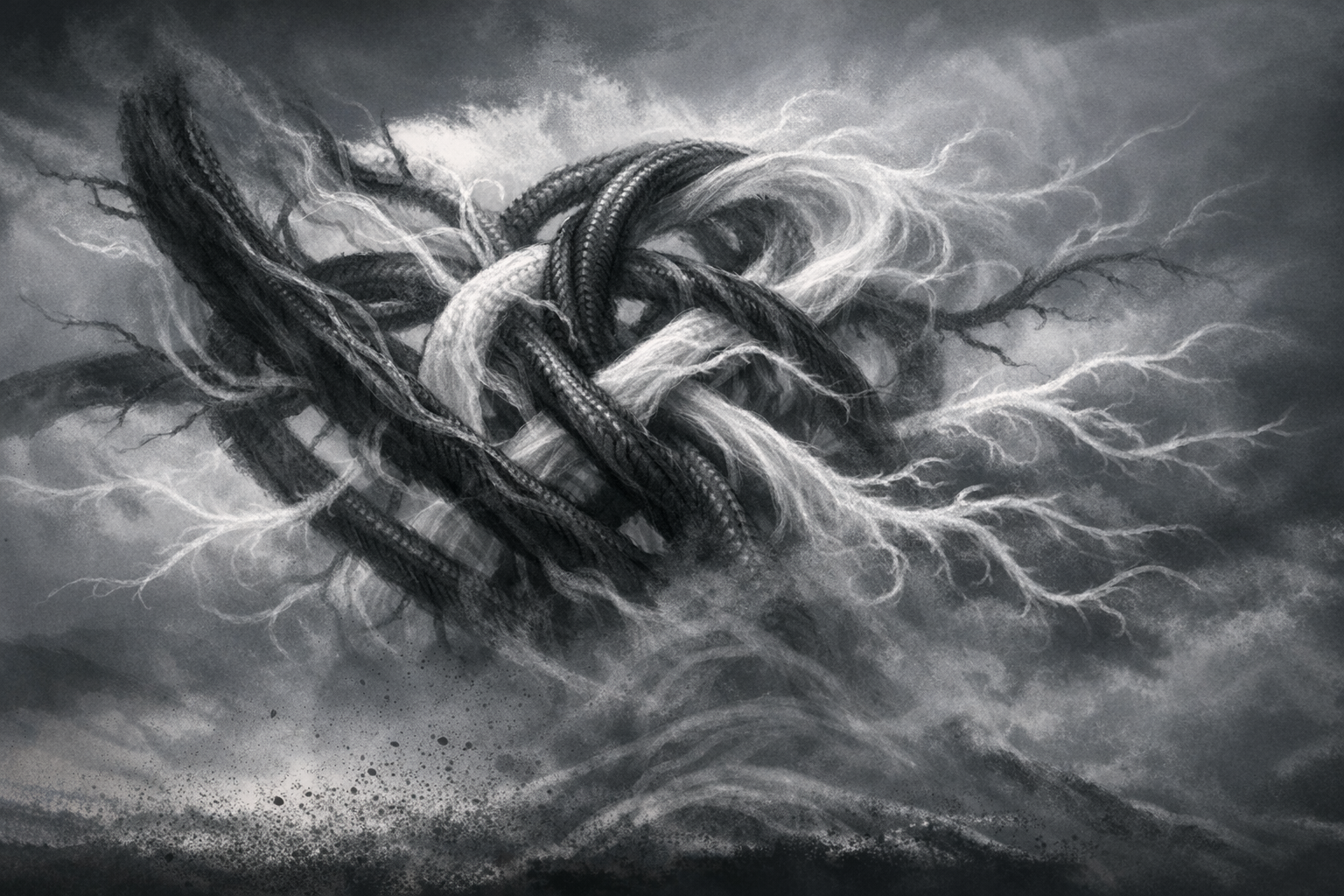
Pastor Pete closed the office door and leaned back against it, exhaling. That was when he noticed the room was full. Not cluttered, woven. Black and White Strands draped the office like an unseen tapestry. They crossed the ceiling beams, dipped through shelves of hymnals, threaded the air in front of his desk. Some lay thick as rope, others no more than breath thin wisps. They did not block his sight. They simply were, layered over the world like a second truth. Pete swallowed.
Since the shift in vision that reduced his world to shades of black and white, he alone could see these odd filaments, these Strands. He took a cautious step forward. As he entered the room the strands brushed him and for the first time, he felt them. The white carried a deep warmth, not on the skin but somewhere farther in, a gentle pressure behind the ribs. The black was the opposite: a cold that slid straight into the bones, quiet, intimate and wrong. Disturbed, Pete dropped into his chair and stared at his hands resting on the desk. “What are you?” he murmured. No answer. Just the slow, patient drift of the Strands. After a long moment, curiosity outweighed fear. Pete reached out. He pinched a single white thread between his fingers. It was there. Not resistance, exactly but presence. The warmth deepened as his fingers followed its length, slow and careful, like touching a live wire you somehow trust won’t bite. The farther he traced it, the more aware he became of himself, not his body, but something inward. A quiet center he had never had words for.
On impulse, he gestured, curling his finger to twist the Strand in on itself. To his surprise, it moved. He drew it closer. It obeyed, pliant and effortless. A laugh escaped him, small, surprised, almost boyish. He looped it loosely, weaving it around itself, shaping it the way one idly twists string while thinking. The strand responded, cooperative, pleased. Then, on a whim, he followed it back toward where it branched and gave a sudden, brisk tug, like plucking a flowers stem. The strand snapped. The loose end dissolved instantly into a soft wisp of white smoke, gone before it could fall. Pete’s smile vanished. His breath caught. Fear crept in, slow and heavy.
After a long hesitation, he turned his attention to the Black Strand that passed directly through his desk, slicing cleanly through wood as if the desk weren’t there at all. He followed it carefully, searching for its thinnest offshoot. When he touched it—Cold. Not just chill. Violation. The kind of cold that reminded him of guilt, of nights he’d lied too easily and slept too well afterward. He slid his fingers along it, mirroring what he had done before. The Strand moved. Worse, it leaned toward him. Pete recoiled, heart hammering. His chair rolled back hard, tipping. He went down in a clatter of wood, breath and fear, landing flat on the floor. The door opened. Sister Selma poked her head in. “Pastor? Everything alright?” Pete scrambled upright, forcing a laugh that sounded wrong even to him. “Fine. Just, missed the chair.” She studied him a second too long, then nodded. “You want the door—” “Yes. Please.” The door clicked shut. Silence rushed back in. Pete stood slowly. His hands were shaking. He looked at the Black Strand again, disgust rising sharp and sudden. It threaded through his office like it belonged there. “No!” he said aloud.
This time, when he reached for it, there was no hesitation. He grabbed the Strand and yanked. It felt solid in his grip, it resisted. Not like a rope, but like roots, like something alive, writhing against his grip, recoiling from his touch. Fear and revulsion drove him as he lashed it aside, the motion instinctive, fierce. The strand tore free. It didn’t dissolve. It withdrew, snapping back into its greater trunk, retreating through the ceiling until only the faintest trace remained. A single black filament poking through the plaster, barely visible. Waiting.
Pete stared at it, chest heaving. It felt like being watched. Or worse, invited. He backed away and sat heavily on the floor, hands pressed flat to the ground, as if grounding himself against what he had just learned. He could touch it. He had touched the Strands for the first time and he knew with terrible certainty it would not be the last.
The Second Measure
Brother Grimm chose the moment carefully. Midday. Busy. Public. If he was going to master himself, he would not do it in shadows. Sister Selma stood near the front of the sanctuary, organizing work details for the afternoon. Her voice was steady, practical. People leaned in when she spoke. Not because she demanded it but because they wanted to. Grimm watched from the back pew. He had spent two nights replaying the basement confrontation in his mind. The tremor in his hand. The release of the boy. The look in the congregation’s eyes. Humiliation. Worse than humiliation had been the truth inside it. He told himself this would be correction. A recalibration. If he could stand before her without that… pressure… then he would know he was not broken, that he was not the one tarnished.
He walked forward. Each step felt deliberate. “Sister Selma,” he said. She turned. There was no challenge in her face. No triumph. No subtle reminder of what had happened. That unsettled him more than mockery would have. “Yes, Brother Grimm?” He moved closer. Too close. He could have stopped at conversational distance. He didn’t. He stepped into reach. Pete, across the room, went still. Grimm felt the air change again, faintly. Like the moment before a storm when pressure shifts just enough to notice. He held her gaze on purpose this time. He would not look away. “I believe,” he began evenly, “that firmness is still required in these times. Discipline. Structure. Mercy without consequence breeds decay.” There. Measured. Controlled. Her eyes did not harden. “I agree structure matters,” she said. “But cruelty is not structure.” There it was. That quiet certainty. The Light stirred. He felt it like warmth against his face, not invasive, not forceful. Just present. He braced himself internally. This time he would not tremble. This time he would not falter. He reached for anger to anchor him. It came easily. Who was she to measure him? Who was she to disrupt order he had worked years to enforce? The anger flared hot and then collapsed. Because beneath it was something rawer. Memory.
He saw again the woman from years ago, Allison. Widowed, desperate. He had publicly rebuked her for questioning his interpretation of scripture. Called her prideful. Unsubmissive. She had wept. He had told himself tears were repentance. Later when he learned she had left the church entirely he had felt vindicated. Now, standing before Selma, he saw it differently. He had not corrected her. He had crushed her. The warmth intensified. Not because she commanded it, because he stepped willingly into the space of judgment. He pushed back with will alone. I am righteous. I am necessary. I am— His breath hitched. Her eyes were steady. Not accusing. Not superior. Just… seeing and what she saw was a man who had used certainty to hide insecurity. His hands began to shake again. He hated that. He hated the weakness. He tried to speak and found his throat tight. “You undermine authority,” he said, but the words sounded hollow even to him. “Authority isn’t the same as control,” she replied gently.
The Light pressed deeper. Not burning. Revealing. Suddenly he was not angry. He was tired, so tired. Tired of holding himself rigid. Tired of guarding against doubt. Tired of justifying the small cruelties as necessary. His knees felt unsteady. He did not look away this time. Unbidden tears gathered. He hadn’t cried in years. “I did what I thought was right,” he said hoarsely. “I know,” Selma answered. That undid him. No condemnation. No “you were wrong.” Just acknowledgment. His vision blurred. He saw faces, not just Allison. Others. Small humiliations he had administered in the name of discipline. The boy in the basement. The way fear had flickered in their eyes. He had called it respect. It had been fear. The anger drained out of him, leaving only grief. Grief for harm done. Grief for pride. Grief for the man he might have been if he had allowed softness earlier.
Her presence held him in that space, unable to lash out, unable to reassert dominance. Forced to feel. “I don’t know how to be different,” he admitted quietly. It was not said for the room. It was said for her and just maybe for himself. Selma stepped no closer, no farther. “You start by not pretending any more” she said. The Light warmed, steady and patient. He bowed his head. Not in theatrical prayer. Not in performance. In surrender. Not to her. To truth. The encounter ended not with retreat, but with collapse inward, with reflection in his own tarnished mirror.
When he finally stepped back, it was not in anger. It was in thought. Pete exhaled slowly from across the sanctuary. He had expected confrontation. What he witnessed instead was transformation beginning. Brother Grimm moved toward the exit again, but slower this time. He did not feel humiliated now. He felt… exposed and strangely lighter. Outside, he stood beneath the gray sky and whispered, voice breaking: “I have been wrong.” The words did not shatter him. They freed him. The first true act of repentance is not punishment. It is clarity. In his challenge to Sister Selma Brother Grimm had just failed again but this time, failure was mercy.
A Private Prayer
The Fellowship church had never been truly beautiful. It had been useful. Strategic. A stage. Even now, after the Outage, with power gone and windows cracked from distant shockwaves, it still felt like a set piece, rows of empty pews, donation envelopes scattered like fallen leaves, a cross mounted slightly crooked above the pulpit. Sister Selma stood alone near the front, hands folded tightly enough to ache. For nearly five years she and Pete had moved from town to town together, revivals, miracle healings, small-town congregations hungry for hope. She handled logistics, the books, the whispers in the crowd. He handled the stage, the sermon, the tears. They had been good at it. Too good. Somewhere between motel rooms and late night laughter over cheap takeout, she had seen it, the thing no one else had. Pete’s hesitation before taking money from the truly desperate. The way he always diverted a portion quietly to families who needed it most. The way he stayed after a service when cameras were gone, listening to someone who just needed to talk. He called it “managing optics.” She called it kindness. And she had loved him for it. Loved him quietly. Faithfully. Stupidly. Now the world was unraveling outside these cracked stained-glass windows. People were dying. Rising. The Strand, whatever it was had begun threading itself through reality and fear had burned away her patience.
She heard his footsteps before she saw him. “Sis?” Pete’s voice echoed softly through the sanctuary. “You wanted to talk?” He looked tired. Not stage tired. Not performance tired. Soul tired. His jacket hung open, shirt sleeves rolled up, collar loosened. He had stopped pretending, at least with her. “Yes,” she said, and her voice nearly failed her. He stepped closer, casual, familiar. “What’s wrong?” Everything, she wanted to say. Instead, she stared at the dust drifting in the late afternoon light. “I don’t think we have time anymore,” she said quietly. “For what?” “For later.” He frowned, not understanding. “Selma—” “I love you.” She interrupted. The words landed between them like something fragile and breakable. Pete blinked.
There it was, the unpreparedness. The way his posture shifted back half an inch. Not rejection. Not cruelty. Just surprise. A man who had walked into so many traps and didn’t know if this was one. “Selma…” he began, gentle, cautious. She could already hear it. The careful tone. The friend tone. “I know,” she said quickly. “You don’t have to say it. I know what I am to you.” That part didn’t hurt as much as she’d feared. It had been true for a long time. Loyal partner. Co-conspirator. Friend. But she stepped closer anyway. “I’ve watched you,” she continued. “The real you. The one you pretend doesn’t exist. The world may be ending, Pete, and I may never get another chance to say this.” His jaw tightened. “Selma, this isn’t—” She kissed him. It wasn’t elegant. It wasn’t practiced. It was desperate and soft and trembling all at once. Her hands came up to his collar, fingers curling into the fabric as if to steady herself. He stiffened in shock. And then, Warmth. Not from him. From somewhere deeper. It bloomed in her chest like sunrise behind closed eyes. She gasped.
It was nothing like the Dark Strand Pete had described in hushed, shaken moments, the cold hunger, the pull downward. This was warmth. Not consuming. Not demanding. Inviting. It felt like standing in sunlight after years underground. It saw her. Her love. Her loyalty. Her choice to act despite fear. And it answered. The warmth flowed into her, not overwhelming, not devouring. Just enough. A thread weaving gently through her being. Inside her, something shifted. A scale she had never consciously seen, tilted. The quiet compromises. The lies justified. The moral gray she had lived in for years. One slot on the darker side of that unseen scale slid away. Gone. Not ripped out. Simply no longer available. She felt it as certainty. There were lines she would never cross again. Even for survival. Even for him.
Her breath hitched sharply. She pulled back from the kiss, eyes wide. Pete stared at her, stunned. “Selma…?” She could feel it still, the warmth humming faintly under her skin. Not power exactly. Not like Pete described. But clarity. Purpose. Leadership. A steadiness she had never possessed before. It frightened her. Because it wasn’t about him. It was about her. The Light had touched her and she had changed. She stepped back as if burned. “I—I’m sorry,” she whispered, though she wasn’t sure what she was apologizing for. Pete looked conflicted. Confused. Maybe even a little shaken. “Selma, I didn’t— I mean, I care about you, you know that. I just—” She shook her head. “I know.” And she did. More clearly than ever. She had loved him. She still did. But the love no longer bent her. The warmth inside her would not allow her to diminish herself for anyone, not even him.
Fear surged through her, not of rejection, but of what she was becoming. She turned and fled down the side aisle, shoes echoing sharply against the sanctuary floor. “Selma!” Pete called after her. She didn’t stop. She burst through the side door into the fading light outside, chest heaving, hands trembling not from heartbreak, but from awakening. Behind her, inside the dim church, Pastor Pete stood alone beneath the crooked cross. Confused. Conflicted. Entirely unaware that something holy had just chosen her.
What the Light Refuses
It was three nights after she kissed him. Three nights of distance. Not coldness, Selma was never cold, but something steadier now. She moved through the Fellowship church differently. Spoke differently. She listened more. Interrupted less. When people argued over food rations or shelter assignments, they turned to her. She did not manipulate them, she guided them. Pete stood at the back of the sanctuary watching her settle a disagreement between two frightened volunteers. No raised voice. No theatrics. No scripture weaponized for control. Just quiet certainty and they listened.
He felt it then, faint, like heat over pavement. The Light Strand. He could see it when he chose to look. Most people couldn’t. Selma couldn’t. The world was still unaware of what threaded through it now. Pete had discovered early that he could touch it, either side of it. Light or Dark. He could pull a whisper of it into his words, lace it into a sermon, press it into a desperate soul and make them believe harder than they ever had before. It worked through him. It responded to him. But it never stayed with him. With Selma… It lingered. Not bright. Not blazing. Just a soft, steady radiance beneath her skin, like a candle cupped in careful hands. It had chosen her. He swallowed. She laughed at something one of the volunteers said, and he felt it hit him like a physical thing. God, he loved her. Not the partner. Not the accomplice. Not the loyal right hand who kept the books straight and the lies aligned. Her. The woman who had seen both the good and the bad in him and loved him anyway. The realization unfolded slowly and painfully honest. He had loved her for longer than he’d admitted. He just hadn’t wanted the weight of it. Love meant vulnerability. It meant accountability. It meant he couldn’t run. She turned slightly and their eyes met across the room. There was no accusation in her gaze. That was what undid him. Before, there had always been a quiet hoping in her eyes. A waiting. A softness angled toward him. Now? She stood straight in herself. She didn’t need him to complete the picture.
The Light shimmered faintly around her shoulders, not visible to others, but to him it was unmistakable. It curved along her like breath on glass. He focused, reaching inward the way he had learned to. The Strand responded immediately. Warmth gathered in his chest. He could pull it in, amplify it, let it flow through his voice, his hands. He had done it before, nudged despair into hope, bent anger toward forgiveness. The Light would work through him. Even for him. But as he reached for it now, not to perform, not to persuade, but simply to hold it, it slipped. Not rejected. Not denied. Just… not his. It flowed around him. Toward her. He felt the difference with painful clarity. He could wield it. She embodied it. The Light had not chosen him. And in the same breath, he understood why. Selma had kissed him without calculation. Without leverage. Without strategy. Without expectation. Just love. Pete had never done anything without an angle. Even his goodness had been moderated by a need for approval or a need for survival but never just a pure need to do good.
He stepped forward slowly as the volunteers dispersed. “Selma.” She turned, and that small, steady glow seemed to brighten just slightly in acknowledgment. Not because of him, but because she was fully present. “Yes?” He stopped a few feet away. For once, he had no script. “I’ve been thinking,” he said carefully. “That’s usually dangerous,” she replied, a hint of her old humor flickering, but grounded now, not self-deprecating. He exhaled sharply, almost a laugh. “I was a fool.” She didn’t rescue him from the statement. “I didn’t know what I felt,” he continued. “Or maybe I did and didn’t want to.” The Light stirred faintly around her, warm and patient. “I love you,” he said. There. No stage. No audience. No crescendo. Just truth. Something flickered across her face, hope, yes, but tempered. She didn’t collapse into it. Didn’t rush him. She searched him. For performance. For manipulation. For an angle. He let her look. “I don’t expect anything,” he added quietly. “I just needed you to know.” The Strand brushed him again, testing. He could have pulled from it then, could have magnified the moment, made his confession blaze with divine resonance. He didn’t. For once in his life, he let the words stand on their own. Selma stepped closer, not all the way, just enough to narrow the space between them. “I never stopped loving you,” she said softly. “But I won’t shrink for you.” “I know,” he answered. And he did.
That was the difference now. The Light had chosen her because she had chosen truth without needing reward. Pete had always needed the outcome. As he stood there, he felt both the Light and the Dark humming at the edges of his awareness. He could take either. He could draw them inward and change himself. But the Light did not enter. It waited. Perhaps it always would, for him. Selma reached out and touched his hand, gentle, steady. The warmth in her did not flow into him. But it did not reject him either. It simply existed. For the first time in his life, Pastor Pete understood that love was not something you orchestrated or expected in return. It was something you became worthy of.
Ascension
The thing Selma noticed first was not temptation. It was the absence of temptation. Anger no longer came when it should have. Fear dulled quickly. The sharp edge of selfish want, the "I deserve this" voice, had gone quiet, as if it had been gently, irrevocably closed behind a door. She could still judge right from wrong. But wrong no longer felt available. Even neutrality was slipping away. The quiet, human space where compromise lived was narrowing, slot by slot, like a mechanism ratcheting toward a final position. Good, purity, was no longer a choice. It was becoming a condition. That was what frightened her.
She found Pastor Pete in the small room behind the chapel, where the generator noise softened into a distant thrum. He was sitting at the table, sleeves rolled up, collar loosened, too human, too present for what she was becoming. She smiled, but it didn’t reach her eyes. “I feel like I’m fading,” she confessed. She sat across from him, hands folded, posture careful, as if restraint itself might slow the process. “Pete,” she said, and her voice trembled despite her control. “I need something from you and I’m afraid if I don’t ask now, I never will.” He waited. He always waited. That was one of the ways he loved her. “I can feel parts of myself, slipping away,” she continued. “Not dying. Not corrupting. Just… fading. I don’t think I’ll be able to want the way I used to for much longer.” Understanding dawned in his eyes. “I love You,” she said quickly. “But soon it will be different. Broader. Kinder. Less mine.” She reached for his hand.
The touch startled them both. “This,” she whispered. “This wanting. This choosing one person over the rest of the world. It’s selfish and I can feel the Light pressuring against it.” Pete swallowed. He took her hand. His thumb brushed her knuckles, reverent, restrained. The touch burned, not with heat, but with awareness. He wanted her. God help him, he wanted her. Not abstractly. Not theologically. Her. The way she folded her hands when thinking. The crease near her mouth when she was trying not to smile. The softness in her voice when she said his name without title. That wanting suddenly felt like theft. “You don’t owe the Light your humanity,” he said. She shook her head. “That’s the terrible thing,” she replied. “I think I do.”
When she leaned in, it was not desperate. It was deliberate. Their foreheads touched. Breath mingled. The room felt smaller, heavier, as if something vast had paused, waiting to see what she would choose. If she crossed this line, she knew, it would cost her. Not corruption. Not sin. But individuality. Love like this favored one soul over all others. The Light did not forbid it but it did not encourage it either. Pete kissed her gently, as if asking permission not just of her, but of whatever watched through her eyes. In that moment as their bodies became one she felt fully human again. Not holy. Not radiant. Not chosen. Just Selma. Somewhere deep inside, she felt a quiet resistance give way. Not a snap. A surrender.
Afterward, she rested her head against his chest, listening to a heartbeat that was not her own. She could already feel the difference. Love was still there. But it had shifted, less possessive, less sharp. The Light smoothed it, polished it, expanded it. Pete felt it too. He held her tighter, as if trying to anchor what remained. She closed her eyes. “I’m still me,” she said, though she wasn’t sure anymore who she was reassuring.
Morning Light
The cold did not wake her. The absence did. Sister Selma lay still for a long moment, listening to Pastor Pete’s breathing beside her. Uneven, human, threaded with the faint ache of exhaustion. His arm rested across her waist, protective even in sleep, as if the night might still try to take her from him. She remembered the hours before dawn. The way he had held her as if trying to anchor something already drifting. The way he had whispered her name, not in prayer, not in fear, but in need. She had answered him. She had wanted to answer him. But now, in the pale gray of morning, she understood something frightening. The act had not deepened her love. It had not sharpened it. It had not narrowed it. It had not claimed her. It had been… complete and then finished.
She turned her head slightly, studying his face. There were lines there she had learned by heart, worry carved by responsibility, kindness worn thin by too many nights of watching people die. She still loved him. That was true. The Light had not stolen that. But the love no longer reached for him. It did not cling. It did not ache. It did not whisper "choose me". It simply was. The same way the sun was. The same way mercy was. She felt, dimly, the truth that he would wake too soon. That he would still want her. Still need her. Still feel the old, human hunger to be known above others and she could not meet him there anymore. Selma eased herself from the bed. The movement was careful, reverent, as if she were stepping away from something sacred, not abandoning it. The sheets cooled instantly where she had lain, a small, cruel proof of what was leaving.
She dressed quietly. Button. Sleeve. Shoes in hand. At the door, she hesitated. Not because she doubted. But because doubt was no longer what guided her. She returned to the bedside. Knelt and pressed her lips gently to his temple. A kiss of gratitude. A kiss of farewell. A kiss without possession. “Thank you,” she whispered, not for the night, but for the years. Pete stirred, brow furrowing, reaching instinctively for warmth that was already gone. She did not let herself be pulled back. Sister Selma stood, straightened, and left the room without looking back. In the hallway, the Light within her remained steady. Unmoved. Unchanged. She felt no surge of sorrow, only a soft, solemn knowing. This had been the last time she could love him as a woman loves a man. What remained was far deeper and far lonelier.
Morning
Pastor Pete woke reaching. His hand found only cool sheet. For a moment he smiled, thinking she had risen early, prayer, patrol, something necessary. Then he felt it. Not absence, loss. The room still held her warmth and her sent but the air felt altered, like a sanctuary after the candles have burned out. Sacred. Emptied. He sat up slowly. Her clothes were gone. Her boots gone. No note. Selma had never needed notes. He lay back and stared at the ceiling. He tried to name what bothered him. It wasn’t that she had left the bed. It was that deep down he already knew why.
The night before had been tender. Human. Needed. He had felt something desperate in himself, not lust, not conquest but the ache to be chosen. To matter more than the rest of the world, if only for a few hours. She had come to him freely. But now, in the clarity of morning, he knew something he hadn’t allowed himself to admit in the dark: She had not clung afterward. She had not curled closer. She had not reached in sleep. She had rested beside him the way one rests beside a river, peacefully, without possession. Pete swung his legs off the bed and buried his face in his hands. He was ashamed of what rose in him next. Not jealousy. Something smaller. Pettier. He wanted her to need him. Not for leadership. Not for counsel. Not for moral balance. For herself alone. That wanting felt embarrassingly adolescent against the scale of the world’s collapse.
When he found her in the courtyard, she was binding a wound on a stranger’s arm. Her expression was focused. Gentle. Exact. The same gentleness she had used with him hours before. The same. That was the fracture. She looked up when she sensed him. “Good morning,” she said, and the warmth in her voice was real. He almost wished it weren’t. “Morning,” he replied. He watched her finish the bandage. Watched the gratitude in the stranger’s eyes. Watched her nod, the same nod she had given Pete a thousand times. Equal. Equal. Equal. “Did you sleep?” she asked. “Yes.” That was not the question he wanted. He took a breath. “Selma,” he said quietly, “did last night mean the same to you as it did to me?” She did not deflect. “It meant love,” she said. “That’s not what I asked.” She held his gaze steadily. He saw it clearly now, not coldness, not indifference but absence of preference. “It did not deepen anything,” she admitted. The honesty struck clean. “No,” she continued gently. “It did not change my love for you.” Pete nodded once. There it was. For him, it had deepened. Rooted. Intensified. For her, it had completed and settled it.
He turned away, walking a few steps before stopping himself. He would not lash out. He would not accuse her of being less human when she had sacrificed more than anyone. But something in him twisted anyway. “I don’t resent your goodness,” he said, still facing away. “I resent that I don’t, weigh more.” Silence. He felt foolish the moment the words left him. They were imperfect but true. She stepped closer. “You weigh what you weigh,” she said softly. He almost laughed. “That’s exactly it.” He turned to face her. “I want to weigh more, to you.” The admission hung between them, fragile and raw. Not pride. Not dominance. Just the human hunger to be singular. Her expression softened further, if that was even possible. “I cannot tilt that scale,” she said. “Not anymore.” The phrase landed heavier than accusation ever could.... Not anymore. There had been a time she would have. A time she would have chosen him first and justified it later. Now the justification came first and the choice never bent.
Pete felt the resentment then, not hot, not explosive. Cold. A thin layer of frost forming over something tender. He hated himself for it. He hated that Grimm, reckless and flawed, would have thrown the scale over entirely for someone he loved. He hated that Selma would save thirty and let him fall, even if it were correctly so. Most of all, he hated that she was right. “I don’t want you to be less,” he said finally. “I just don’t know how to stand beside you if I’m not special to you.” She did not answer immediately. Because there was no answer that would restore what had shifted. “You are loved,” she said. It was true. It was devastating.
That night, when they lay beside each other again, she did not reach for him. Pete stared into the dark and understood something final. She would never again burn for him, never again reach for him. She would never again fight the Light for the sake of human love, human need. He realized, he would have to decide whether loving her meant accepting that.
A Soul Saved
They laid the bodies out in rows beneath the overhang, rain tapping softly on tarps and broken hymn boards. The wounded were placed closest to the doors, where the light was steadier and hands were near. Some cried out. Some stared. Some were already too still. Pastor Pete moved among them quietly. He did not preach. He did not pray aloud. This was no time for theater. He just knelt, touched shoulders, closed eyes when it was time.
Pastor Pete felt its cold darkness before he saw it. That presence only his eyes could see. A thin Black Strand slid from the air itself, delicate as spider silk, drifting toward one of the elders from the congregation. Mr. Holloway. A man who had sung off key every Sunday and laughed at himself when corrected. His leg was crushed. There was no fixing it, no saving him. Each breath came sharp and wet. Fear poured off him in waves. The Strand hovered inches above his chest. “No,” Pete whispered with quiet confidence. The strand pulsed, thickening slightly, as if listening. It bent toward the man’s face, brushing his cheek. Mr. Holloway’s eyes snapped open. “I don’t want to go,” the old man rasped. “It says I don’t have to.” Pete took his hand. It was trembling hard enough to rattle bone. “It lies,” Pete said gently. “Darkness always lies.” The Strand slid closer, curling like a beckoning finger. Pete could feel its promise now. Not life, not truly, but movement. Hunger. A way to avoid the quiet that comes after that last breath. Mr. Holloway’s grip tightened. “I’m scared,” he said. “Pastor, I hurt so bad.” “I know,” Pete said. He could have cast the darkness out, lashed the Strand away, instead he did something harder. Pastor Pete leaned close, forehead nearly touching the man’s. He spoke softly, steadily, the way he had learned long before the world ended, when death was still allowed to be gentle. “You are not alone,” Pete said. “You are seen. You are loved. You don’t have to bargain with the Dark to be remembered.” The black Strand shuddered, pressing closer, desperate now. It touched the dying mans arm. flowed up his chest. It sought to embrace him but he resisted its touch and its false promise. A quiet refusal, a surrender to peace, to truth and not to lies. The Strand recoiled.
Mr. Holloway sobbed once, a small sound, then relaxed. His breathing slowed. The pain eased from his face, lines softening like a tide pulling back. “Will you stay?” the man asked. Pete nodded. “I’m here.” The strand thinned, stretched, then withdrew, unraveling into nothing as if it had never been there at all. Mr. Holloway’s hand went slack. Pastor Pete’s hands shook as he closed the man's eyes. He continued to kneel as the rain washed blood from the concrete.
He felt no triumph. No righteousness. Only the same sickening awe he had felt beside the child’s bed not so many days ago. Pete looked up at the colorless sky, at the vast entwined forces moving patiently overhead. He did not know whether this power was a gift, a test, or a punishment. Only that it had chosen him and on this day it had chosen him, not to save a life but to save a soul.
This is incredibly powerful the Strands as visible morality, Selma embodying the Light while Pete can only wield it, and Grimm’s slow repentance all feel profound and earned. The emotional tension is just as gripping as the cosmic one.
Are you building toward a moment where someone must choose between love and becoming something more than human?
I am trying to evolve that moment for Sister Selma more than for the others. Of course I hope they evolve and grow as well. Thanks for reading what I have and for the comment. It is encouraging.
That sounds like a really compelling direction for Sister Selma focusing that evolution through her makes the theme feel much more intentional and personal. I’m very curious to see how that moment ultimately unfolds for her.
Also, would you be comfortable connecting with readers on another platform to discuss the story further?
The piece has an intriguing urban fantasy vibe that makes the Dark Hammer world feel rich and atmospheric even in snapshot form.How do the character stories in Outage connect to the larger events of the Dark Hammer campaign world, and will we see those threads expanded into full narratives?
The characters in the story are from my tabletop campaign. These stories blend personal character development with events form some of the games sessions that have been played. I will be releasing other chapters that feature other crews from the campaign. Thanks for reading and for the engaging questions.
That’s really awesome I love how you’re blending actual campaign moments with character development, it makes the world feel super authentic. I’ll definitely look forward to the other crews’ chapters. Also, if you’d ever like to chat more about your writing, I’d love to connect on Discord or Tumblr if you’re comfortable





This is incredibly powerful the Strands as visible morality, Selma embodying the Light while Pete can only wield it, and Grimm’s slow repentance all feel profound and earned. The emotional tension is just as gripping as the cosmic one. Are you building toward a moment where someone must choose between love and becoming something more than human?
I am trying to evolve that moment for Sister Selma more than for the others. Of course I hope they evolve and grow as well. Thanks for reading what I have and for the comment. It is encouraging.
That sounds like a really compelling direction for Sister Selma focusing that evolution through her makes the theme feel much more intentional and personal. I’m very curious to see how that moment ultimately unfolds for her. Also, would you be comfortable connecting with readers on another platform to discuss the story further?